A full breakdown of how Gong scaled from $0 to $7.25B using 6 coordinated go-to-market motions — and what B2B SaaS companies can steal for their own pipeline strategy.

Kyle Dickson
March 2, 2026
Most B2B SaaS companies are stuck in the same cycle: inconsistent pipeline, unpredictable revenue, and a go-to-market strategy that's really just "send more emails and hope."
They run cold outbound with no brand behind it. They post on LinkedIn with no content strategy. They buy ads with no organic foundation underneath. And then they wonder why nothing compounds.
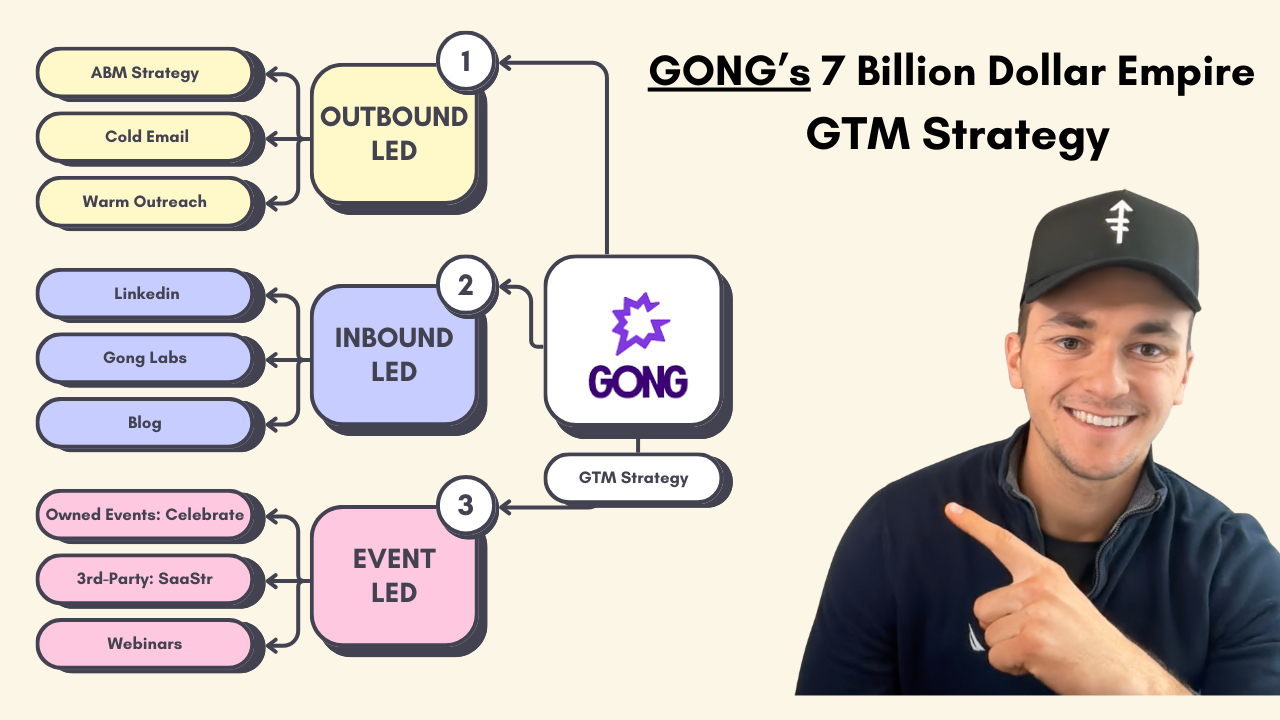
Gong didn't do any of that. They built a $7.25 billion company by running 6 coordinated growth motions simultaneously — each one feeding the others — and the result was a pipeline machine that most SaaS companies can only dream about.
I spent weeks breaking down every tactic Gong used across every growth motion. Here's the full playbook.
Before diving into tactics, it's worth understanding why Gong grew so fast. They solved three pain points that almost every B2B SaaS sales org experiences:
First, sales teams operate blind. Reps and managers make decisions based on gut feelings, self-reported CRM notes, and anecdotal deal updates instead of actual conversation data. There's zero visibility into what's really happening on calls.
Second, revenue forecasts are broken. 80% of companies missed their revenue targets in the last two years. Pipeline health is a guessing game. Deals stall and die without anyone knowing why until it's too late.
Third, GTM teams are completely siloed. Sales, marketing, and customer success run on disconnected tools with no shared visibility, which kills deal velocity and expansion revenue.
Gong's solution captured every customer interaction — calls, emails, meetings — analyzed them with AI, and gave the entire revenue org a single source of truth. That product-market fit, combined with the GTM execution below, is what created a $7.25B company with 4,800+ customers.
Here's what most SaaS companies get wrong about pipeline generation: they treat each channel as isolated. Gong treated them as one integrated system.
Gong built their event strategy around creating exclusive access that sales could use as ABM currency. Their flagship "Celebrate" conference grew into a sold-out, 900+ attendee event with product launches, breakout sessions, and celebrity keynotes. But it started as a simple 7-city roadshow.
More importantly, they ran invite-only executive dinners at premium venues like Peak NYC and Chase Center SF. Attendance was gated through sales reps and CSMs, which made every dinner a pure ABM activation play. If you were a target account, your sales rep could get you in. That's pipeline leverage.
They also ran a webinar series every 8 weeks anchored by proprietary data from Gong Labs, pulling 2,000+ registrants per event by leading with curiosity-driven topics instead of product pitches. Guest speakers included Robert Cialdini, Forrester analysts, and leaders from Amazon and Slack.
Their Visioneers community meetups were customer-led by industry, interest, or location. Sub-communities like "Women in Revenue" hit 190+ members. And their annual Golden Gong Awards generated case study content by recognizing top customer teams — nearly 200 nominations in 2025 alone.
The key insight: Gong built a community identity around "revenue leaders," not just Gong users. Every event generated a post-event content loop that fed their inbound machine.
This is where Gong separated from every other SaaS company. Their inbound strategy wasn't "publish blog posts and pray." It was a deliberate system designed to build the largest owned audience in their category.
Their most differentiated play was Gong Labs — a proprietary data research blog that analyzed millions of real sales calls to publish insights no competitor could replicate. Topics like "how cursing affects win rates," "when to mention price on calls," and "optimal number of questions for C-suite prospects" were data-backed, specific, and immediately actionable for sales professionals.
They paired this with a pain-point SEO strategy that ranked for 200+ category keywords beyond their core product — terms like "sales coaching software," "call recording software," "ICP in sales," and "sales territory planning." They built content clusters with pillar pages and JTBD-based content mapped directly to customer pain points they extracted from their own sales call data.
On LinkedIn, they grew from 12K to 200K+ followers in roughly two years through a three-pronged approach: short casual videos, value-first posts, and giveaways/contests. Their "12 Days of Swagmas" holiday campaign alone drove an 85% increase in follower growth, 194% increase in likes, and a 6,893% increase in comments in 30 days. LinkedIn was their cheapest demand gen channel — entirely organic.
But the real weapon was the "Gongster Army." They mobilized the entire company to post on LinkedIn. Marketing trained every team — not just executives — on content creation and personal branding. Employees adopted Gong's purple gradient on profile and cover photos. This created a virtuous cycle that attracted talent who already understood content culture.
They also created the "Revenue Intelligence" category after three years in "Conversation Intelligence" — driving organic search demand for a term only Gong could define.
The key insight: Gong built brand before they turned on performance marketing. Their CMO Udi Ledergor's mantra was that content should serve both brand and demand gen simultaneously. Proprietary data was the moat.
Here's where most B2B SaaS companies can learn the most — especially if you're running cold email or cold outbound.
Gong didn't treat outbound as a volume game. They treated it as a premium, high-touch channel for enterprise penetration. Their SDRs acted like mini-consultants, not cold callers.
Their dedicated ABM function split targets into two tiers. The top 50 accounts received fully personalized 1:1 ABM. The next 300 received 1:few campaigns. Cost per SQL in strategic enterprise accounts exceeded $10-20K — and they were fine with that because each deal was worth significantly more.
One of their most creative outbound plays was earnings call prospecting. SDRs combed through quarterly earnings calls of publicly listed target accounts, identified strategic pain points mentioned by executives, then sent annotated transcripts with sticky notes highlighting where Gong could help. Think about the signal that sends to a VP of Sales: "We read your earnings call, understood your challenges, and here's exactly how we solve them."
They also used Sendoso for direct mail and gifting at scale. An SDR used Sendoso's Amazon integration to send a personalized gift to an SVP at a Fortune 500 company. That person took the meeting and posted about the experience on social media. After that success, Sendoso spread across the entire sales org, and they eventually built an automated integration that triggered gift sends when prospects booked meetings.
The critical alignment piece: Marketing reported on SQLs, not MQLs. Sales confirmed whether marketing reached the right target. This built trust between teams and ensured outbound was supported by quality inbound leads rather than fighting against a disjointed brand message.
The key insight: Outbound worked for Gong because every other motion supported it. When a prospect received a cold email, they'd already seen Gong on LinkedIn, heard about them from a colleague, or read a Gong Labs post. Outbound was the closer, not the opener.
Gong's paid strategy was built on one principle: make bold, unconventional bets that create outsized awareness relative to spend. Performance marketing was layered on after brand momentum was established, not before.
Their most famous play was buying regional Super Bowl ad slots in 2021 and 2022. Not national — just specific metros where their target buyers were concentrated (SF, Seattle, NYC in year one; added Chicago and Boston in year two). The 2021 ad cost roughly $250K for regional placement versus the $5-7M national rate. It created their biggest-ever sales pipeline and massive social media buzz. Their CMO set aside 5-10% of program spend annually for experimental, unplanned marketing — later renamed "Marketing Experiments" to be CFO-friendly.
On LinkedIn, they ran paid campaigns featuring "altruistic" content — value-first, not product-first — and video ads featuring real customer decision-makers explaining the problem and how Gong solved it. Google Ads targeted high-intent commercial keywords aligned with top-performing organic content for message consistency.
The key insight: Paid amplified what was already working organically. They never led with paid. They proved content worked organically first, then put budget behind the winners.
Gong leveraged ecosystem-led growth through integration partners like Crossbeam and Sendoso, using account mapping to identify mutual prospects and co-sell into those accounts. They maintained top ratings on G2 to create a passive inbound engine, earned Gartner Magic Quadrant Leader placement in Revenue Action Orchestration, and formalized customer advocacy through their "Outstanding Gongsters" program.
These supporting motions created trust signals and social proof that shortened deal cycles and made both inbound and outbound pipeline convert at higher rates.
This motion is what made Gong unreplicable. Their CMO had a specific formula: pick an offline medium associated with big companies, buy a small or regional version at a fraction of the cost, get creative with it, photograph it, amplify on social channels, and activate employees and customers to share.
The real audience was never the people who saw the physical ad. It was the LinkedIn audience who saw the content about the ad.
Examples: They bought 15 seconds on a small rotating digital billboard in Times Square for a few hundred dollars, sent a photographer to capture it with NYC foot traffic in the background, and posted it on LinkedIn where people assumed it was a massive national campaign. During COVID, they commissioned virtual billboards Photoshopped into Times Square. They purchased a virtual overlay of the Gong logo on the Golden State Warriors court — and by pure luck, Steph Curry broke his three-point record while standing directly on it.
Instead of paying for a booth at Salesforce's Dreamforce, they wrapped Uber and Lyft cars with Gong branding and let them drive through San Francisco during the event. They sent branded food delivery robots through SF streets delivering pizza to potential customers. People photographed them, tagged Gong, and the story spread organically.
The key insight: Every offline play was designed to become an online content asset. The physical world was raw material for the digital amplification machine.
You don't need Gong's budget to apply these principles. Here's what scales down:
Build your outbound on a foundation of content that proves you understand the market. If your cold emails land in the inbox of a VP of Sales and they've never heard of you, your reply rate will reflect that. But if they've seen your name on LinkedIn, read a piece of your content, or heard about you from a peer, that same cold email hits completely differently.
Create proprietary data or insights your competitors can't replicate. For Gong, it was analyzing millions of sales calls. For your SaaS company, it might be anonymized customer data, original research, or frameworks built from real implementation experience.
Treat outbound as a precision tool, not a volume play. Gong's SDRs reading earnings calls and sending annotated transcripts is the gold standard. Research-heavy, hyper-personalized outreach that demonstrates you understand the prospect's specific challenges will always outperform generic templates at scale.
Sequence your motions. Brand and content first, then paid amplification, then precision outbound. Most companies try to run everything at once with no foundation. Gong built the foundation first.
And most importantly, make every piece of content, every event, every campaign serve double duty. Every event should produce content. Every outbound play should reinforce the brand. Every paid campaign should amplify proven organic content. Nothing should exist in isolation.
The revenue intelligence market hit $3.8B in 2024 and is projected to reach $10.7B by 2034 at a 12% CAGR. Platform adoption is increasing 47% year-over-year. Over 75% of US enterprises are actively using or piloting revenue intelligence tools. And AI-powered sales teams are seeing 83% revenue growth compared to 66% for teams without AI.
Gong sits at the center of this with 4,800+ customers, a $7.25B valuation, and hundreds of millions in ARR. The company targets mid-market (200-1K employees) and enterprise (1K+) companies, selling primarily to VP Sales, CROs, RevOps leaders, Sales Managers, and CS leaders across B2B SaaS, financial services, healthcare, and professional services.
Their land-and-expand model works bottom-up: reps adopt and love the product, then leadership buys top-down.
Gong didn't build a $7.25B company by running one channel really well. They built an integrated system where every growth motion reinforced every other motion. Content built brand. Brand made outbound work. Outbound fed events. Events created content. And the whole machine compounded.
If your B2B SaaS company is struggling with inconsistent pipeline, unpredictable revenue, or outbound that isn't converting, the answer probably isn't a better email template. It's building the system around the email that makes the email work.
From the moment you sign a contract, you should count 2 weeks before seeing your first campaign live. The first weeks are dedicated to building your email infrastructure. We’ll set up secondary domains and mailboxes and warm these up. During the warm-up process, we build your lead lists and draft your email (&/or LinkedIn) sequences. This process usually takes 2 weeks – which means that we send our first outreach messages by week 3.
We don’t use your primary domain to send our outreach emails. If you’re doing so, you should stop already, as it can have some disastrous impact on your domain reputation overall. We create secondary domains that redirect to yours. We then create mailboxes to send our emails. Whatever happens with these domains – your main domain reputation is safe. Because we have a handful of different domains, we can scale our sending volume in a safe way.
Once our first drafts are ready, we’ll send them your way for review. We won’t send any messages you’re not happy with. Similarly, we send you the list of prospects we plan to contact before doing so. If you’re not happy with our targeting criteria, we’ll revise and recreate these lead lists.
We charge a monthly retainer. We work on a month-to-month basis. Our goal is to win your business every month by providing a service you’re happy to keep paying for.
No there is zero upfront fees & no hidden costs.

.jpg)